
Go Slowly
"Pole Pole" - Swahili for slowly, slowly. If you cannot manage a conversation comfortably, you are going too fast.
Stay Hydrated
Drink at least 3 litres of water daily. Proper hydration dramatically helps acclimatisation.
Consider Diamox
Proven to help body acclimatise faster. Consult your doctor for prescription.
What is Altitude Sickness?
Altitude sickness, also called Acute Mountain Sickness (AMS), hypobaropathy and soroche, is an illness caused by exposure to the low air pressure, especially low partial pressure of oxygen, which many climbers experience at high altitudes. AMS is caused by exerting yourself at high altitudes, especially if you have not been properly acclimatised. It is most common at altitudes above 2400 metres. Kilimanjaro's peak is nearly 6000 metres above sea level. At this height, the air pressure (and the amount of oxygen it contains) is less than half that at sea level, and has been said to be comparable to 'working with only one lung'.
Not everyone suffers from AMS, of course, and it is very difficult to predict who is or is not vulnerable to it. Generally speaking, a fit person is less vulnerable than an unfit person. Even so, anyone can be vulnerable at altitudes above 3500 metres, no matter their fitness level.
Avoiding AMS
Gradually climb higher each day, then descend lower to sleep.
Keep respiration rate low enough to maintain normal conversation.
At least 3 litres each day.
Helpful in avoiding AMS. Consult your doctor before taking.
Effects of Exposure to Low Atmospheric Pressure
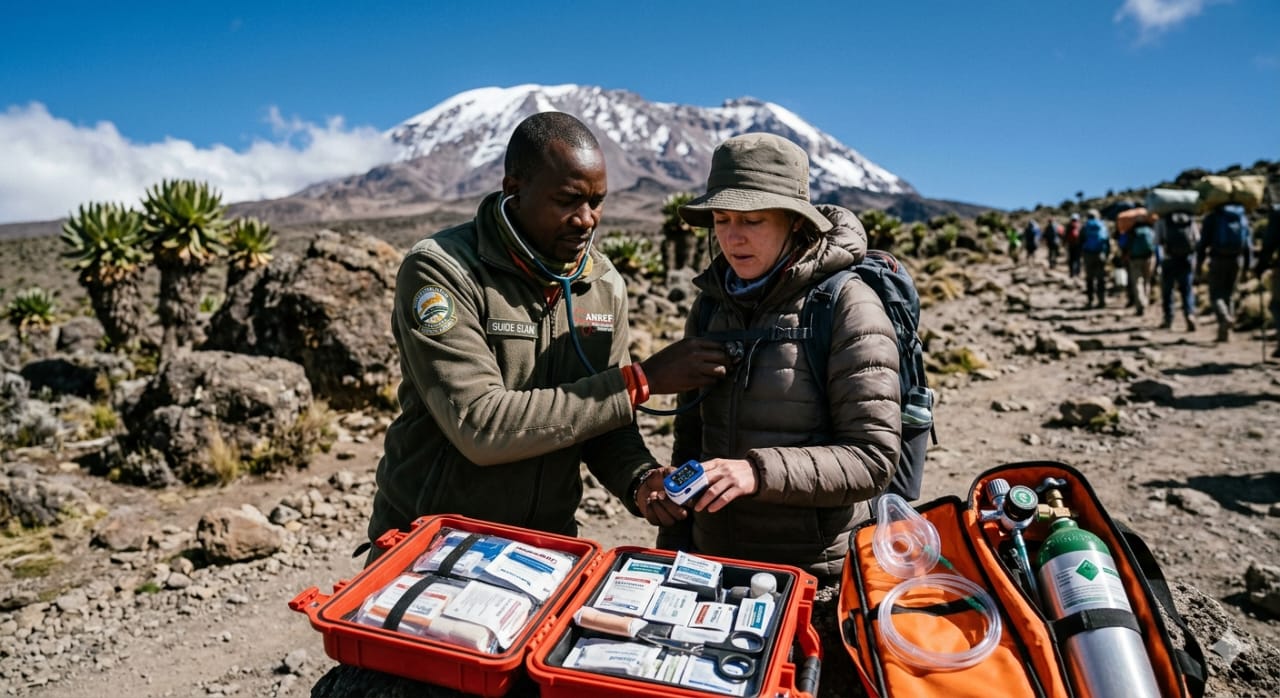
Blood with low oxygen leads to fatigue, breathlessness. Our guides have pulse-oxymeters to check oxygen saturation daily.
Fluid collects in sinuses - presents as mild headache, can cause disorientation, coma.
Fluid seeps into lung air spaces - presents like pneumonia.
How to Recognise AMS
AMS does not present as a slow, gradual worsening. It is generally a rapid, dramatic onset of symptoms that can render a person unable to walk or take care of themselves. Our guides are trained to recognise AMS and apply appropriate first aid.
Our Client Descent Protocol
1) Measuring Oxygen Saturation
If below 80%: Test every half hour for 2 hours. If not rising to 75% → descend immediately. If at least 75% → continue with close monitoring.
2) Evaluation on the Lake Louise Scale
Score 6-8: Guide considers whether you can continue based on score, oxygen saturation, pulse rate. If higher than 8 → descend immediately.
The Single Biggest Reason
The single biggest reason why people fail to summit is because they have not acclimatised well. Follow our guides' advice, stay hydrated, go slowly, and trust the process.